
Mah Chanukah
(What is Chanukah)

Mah Chanukah‘ (What is Chanukah) asks the Talmud.
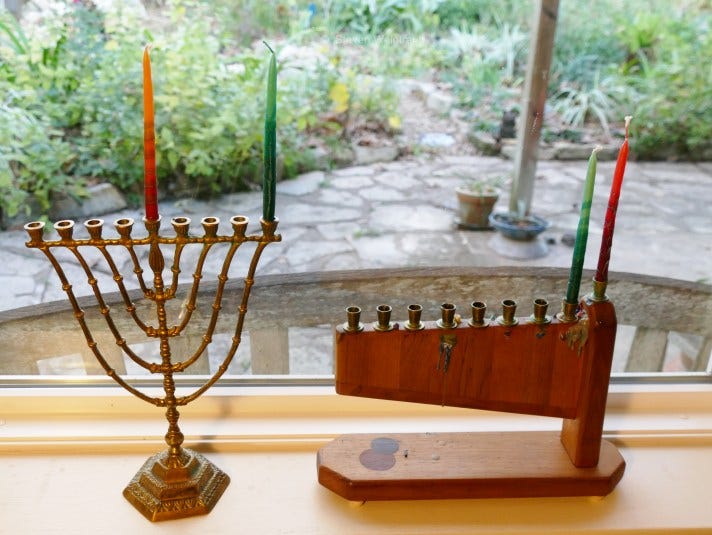
Most of what you’ve heard about Chanukah and its history is heavily mythologized and not accurate. Equivocating Chanukah to Christmas completely misunderstands the holiday. Ironically, the American Thanksgiving is a closer link to this Jewish celebration (I’ll explain that in later in this post).
Chanukah is actually a minor holiday in the Jewish calendar and marks a non-biblical, but historical, event. There are significantly more important holidays in the Jewish calendar, including Sukkot (more about that later). For Chanukah, no special day of convocation is called, no abstention of normal activities is practiced, only extra celebration of the miracle is performed.
Linking Chanukah to a very different religious holiday (Christmas) purely because of the shared season, misunderstands the events Chanukah commemorates. Chanukah enshrines the fight for religious self-determination and identity. Chanukah celebrates the success of the Maccabean rebellion against the Hellenistic Syrian rulers of Israel in the year 165 B.C.E. The Syrians, and (more importantly) the native Jewish Hellenized population, passed decrees outlawing traditional Jewish practices and took control of The Temple in Jerusalem. They assassinated the High Priest, stole the holy vessels and desecrated The Temple by installing their idols and sacrificing swine. The Maccabees led a revolt starting with their father, Mattathias, and later his son, Judah. Against a much larger and better organized army, the Maccabees waged a successful guerilla war that eventually defeated the Syrians. Chanukah celebrates the retaking of the Temple and its re-dedication. In Hebrew, Chanukah means dedication.
The phrase most associated with Chanukah is ‘Nes Gadol Hayah Sham‘ which means “a great miracle happened there.”
What was the miracle?
Most of you have heard the story the crucible of oil and how one day’s supply of oil lasted for eight days during the re-dedication, and this is considered to be the miracle. Well that is not the miracle meant – the story is a myth. If pressed on the issue, most modern Rabbis will admit this. Chanukah is an extensively well chronicled revolt. The book of Maccabees does not mention the miracle of oil, nor do later historians like Josephus. The myth only appears several hundred years later. The great miracle was the victory of a rag-tag, guerilla force over a vastly superior foe. So this leaves open the questions of why the eight days, why the menorah, and where did the oil story come from?
Why eight days? One of the three most important holidays in the Jewish calendar is Sukkot, which is a fall harvest festival. Another theme of Sukkot is re-dedication as the holiday occurs just after Rosh Hashanah–the marking of the new year, and Yom Kippur, the celebration of return and repentance. It was during Sukkot that The Temple was annually cleaned and rededicated. While The Temple was under Syrian control (168-165 B.C.E) re-dedication was not allowed. Once the Maccabees recaptured The Temple, it required the ritual re-dedication. Even though it was two months after the traditional time for Sukkot, they celebrated a ‘late’ Sukkot re-dedication: Maccabees II 10:6 : “And they celebrated eight days of joy as at Sukkot, remembering that not long before celebrating Sukkot in the mountains and caves wandering like beasts of the fields.” As Sukkot lasts eight days – so does Chanukah.
Coincidentally, Sukkot is the inspiration of another holiday; Thanksgiving. The pilgrims, reading in the bible about a holiday of harvest, thanksgiving and rededication, chose to create a celebration for it. So actually, Hanukah and Thanksgiving are sibling holidays inspired by Sukkot.
Why the menorah if there was no miracle? Menorot (Hebrew, plural for menorah) were the way ancient Jews kept count liturgically. The symbol of Judaism (before the Star of David became popular in the 1700’s) was the seven branch menorah for tracking the days between Sabbaths. The symbol is still important; for example, as an emblem on the seal of the State of Israel. The eight branch Chanukah menorah (correctly called a chanukiah) is used for keeping track of the eight days of Chanukah in the same way.
So where did the story of the oil come from? The story first appears in Gamara Shabbat (a Rabbinic section of the Talmud) centuries after the historical events. The story is recounted aggadically, meaning it is not necessarily literal and could be allegorical. This section of the Talmud dates to about 60 CE when the Romans occupied Israel. Given Roman militarism, the Rabbis probably thought that celebrating a Jewish victory over an occupying army was probably not in the best interests of the Jewish people. The Rabbis were trying to de-emphasize the military victory by recounting a popular story about the re-dedication, and give a new meaning to the phrase ‘Nes Gadol Hayah Sham‘ (A great miracle happened there). After all, 10 years later, with the great Jewish revolt of 70 CE, the Jewish population was decimated and exiled. But the story stuck and as we learn from Man Who Shot Liberty Valance: When the legend becomes fact, print the legend. The story of the oil has become part of the Chanukah mythos. As a result, we do all sort of things emphasizing oils: lighting the menorah (traditionally using olive oil), and eating deep fried foods (like latkes and donuts).
Have a good holiday, enjoy, and help celebrate this important victory in Jewish history. A victory that marks the freedom of Jews to practice without the influence and oppression of outside forces.
Thank you, Steven! This provided material for a nice morning discussion. (My grandfather Julius would have loved it.)
Fascinating - thank you!